
Plastic pollution and fossil-fuel dependence are typically treated as separate global crises. One clogs landfills, rivers, and oceans; the other fuels climate change, energy insecurity, and volatile oil markets. Governments respond with plastic bans on one front and renewable or blending mandates on the other.
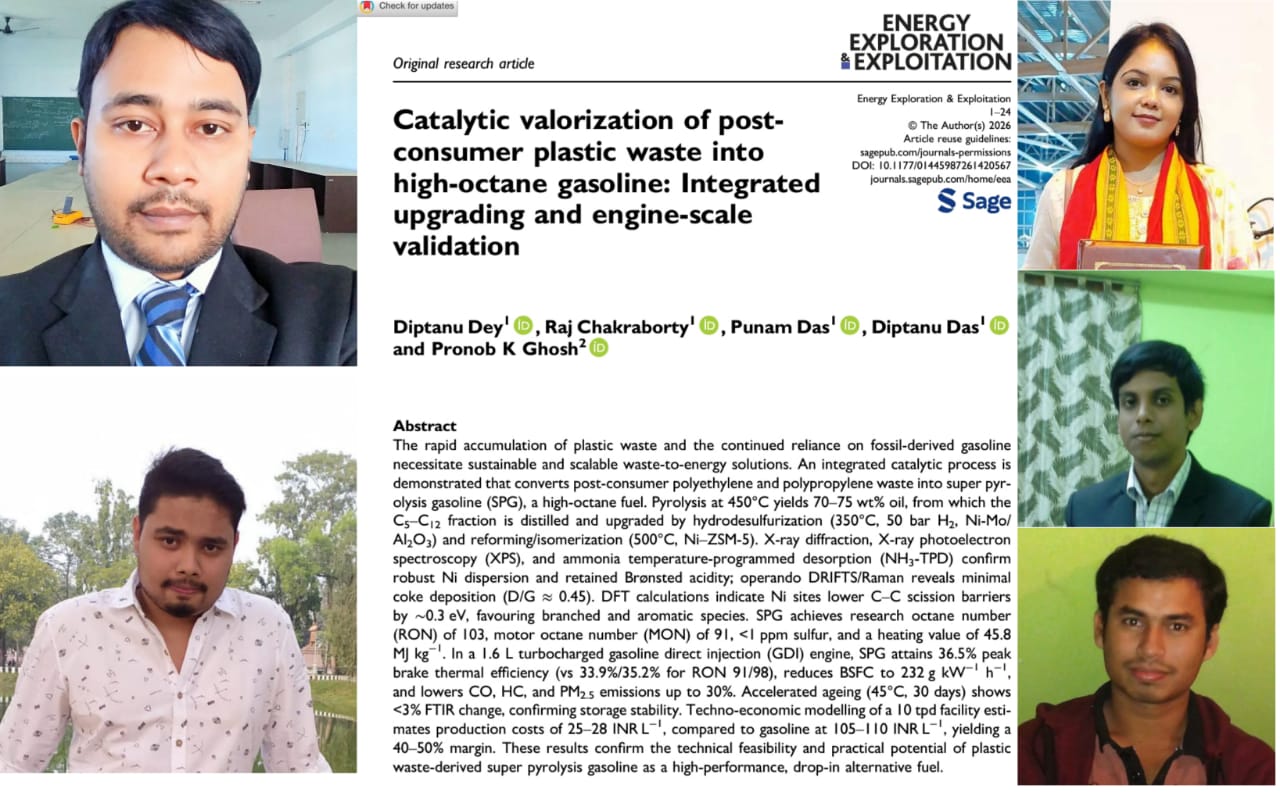
A newly accepted scientific study challenges this long-standing separation with compelling evidence: post-consumer plastic waste can be converted into high-quality gasoline, delivering performance comparable to conventional petrol and validated under real engine operating conditions.
This is not a theoretical promise.
It is a measured, tested, and engine-verified result.
Research from Tripura with Global Relevance
The study has been conducted by Diptanu Dey, Raj Chakraborty, Punam Das, and Diptanu Das of the National Institute of Technology (NIT) Agartala, with contributions from Pronob Ghosh, an alumnus of NIT Agartala currently working in Bangladesh—underscoring the collaborative and cross-border nature of modern scientific research.
That such advanced fuel research originates from Tripura is itself significant. Energy innovation in India is often associated with large industrial or metropolitan hubs. This work demonstrates that rigorous, application-driven innovation can emerge from regions rarely highlighted in national science narratives, while addressing problems of universal relevance.
Plastic Waste: A Crisis with Limited Exit Options
Globally, over 400 million tonnes of plastic are produced each year, yet less than 10% is effectively recycled. Mechanical recycling struggles with contamination, mixed polymers, and quality degradation. Much of the remaining waste is landfilled, incinerated, or escapes into natural ecosystems.
Plastic bans reduce future inflow but do little to address the vast backlog of accumulated waste that will persist for centuries if unmanaged. Incineration recovers some energy but generates harmful emissions, while exporting waste merely shifts the burden elsewhere.
Against this backdrop, recovering fuel-grade energy from plastic waste represents a fundamentally different and pragmatic pathway.
Plastic Is Not Trash—It Is Stored Chemical Energy
Plastics are composed of long-chain hydrocarbons, chemically similar to conventional fuels. Most common plastics possess calorific values between 40–46 MJ/kg, comparable to petrol and diesel.
Discarded plastic, therefore, represents misplaced chemical energy.
The research employs controlled catalytic conversion to break long polymer chains into shorter hydrocarbons within the gasoline boiling range, followed by upgrading to enhance stability and performance. Crucially, success is measured not just by yield—but by fuel quality.
Fuel Quality: Quantified, Not Assumed
The plastic-derived gasoline produced in this study demonstrates strong fuel characteristics:
Research Octane Number (RON): High-80s to low-90s, overlapping with commercial petrol grades
Calorific Value: Approximately 43–44 MJ/kg, closely matching conventional petrol
Combustion Behavior: Stable ignition without abnormal knocking
These metrics matter. Octane rating directly affects engine efficiency and durability, and many alternative fuels fall short in energy density or combustion stability. This fuel does not.
Engine Validation: The Critical Test
What sets this research apart is real engine-scale validation—a stage where many alternative fuel concepts fail.
Under actual engine operating conditions, the fuel demonstrated:
Stable combustion across operating regimes
No abnormal knocking
Comparable power output to conventional petrol
Smooth and reliable ignition response
In engineering terms, this confirms the fuel is functionally equivalent to petrol in real machines, not just chemically similar.
Infrastructure Compatibility: A Major Advantage
Unlike many alternative fuels that require new engines or modified infrastructure, plastic-derived gasoline offers drop-in compatibility:
- No new engines required
- No changes to existing fuel distribution systems
- No reduction in volumetric energy density
- From an adoption and policy perspective, this significantly lowers deployment barriers.
- One Pathway, Two Global Problems
The process simultaneously addresses:
- Plastic Waste Mitigation
- Diverts non-recyclable plastic from landfills and open burning
- Converts waste into a valuable energy product
- Fossil Fuel Substitution
- Each litre of plastic-derived fuel displaces petroleum-derived petrol
- Reduces crude oil demand without new extraction
In practical terms, one tonne of waste plastic can yield approximately 700–800 litres of fuel-range hydrocarbons, depending on feedstock and process conditions—an output that is economically and energetically meaningful.
A Structural Alternative to Ethanol and Biofuels
Ethanol-blended fuels such as E20 suffer from lower energy density and compatibility issues in older engines. Plastic-derived gasoline, by contrast:
Retains full energy density
Does not use agricultural land
Does not compete with food supply
Utilizes an existing waste stream
This makes it a structurally different solution, not a competing biofuel.
Environmental Realism over Idealism
While plastic-derived fuel does emit CO₂ when burned, the relevant comparison is what would otherwise happen to the plastic. Open burning, incineration, or indefinite landfilling all carry environmental costs.
Efficient energy recovery that offsets fossil fuel extraction represents a net environmental improvement under real-world conditions.
Addressing Legacy Plastic, Not Just Future Waste
Plastic bans slow new inflow but ignore decades of accumulated waste. This pathway directly tackles that backlog, closing the material loop:
Fossil fuel → plastic → useful product → recovered energy
Scalable and Deployment-Ready
The process is compatible with:
- Decentralized urban waste-processing units
- Integration into refinery upgrading systems
- Regional fuel supplementation models
- Engine validation substantially reduces scale-up risk, making commercialization more viable.
- A Signal from Tripura to the World
This work from NIT Agartala sends a clear message: impactful, numbers-driven energy research is not confined to major industrial corridors. The collaboration extending into Bangladesh further reflects the global relevance of the challenge—and the solution.
Not a Silver Bullet, but a Serious Solution
No single technology can solve plastic pollution or eliminate fossil fuel use. Reduction, recycling, and renewables remain essential.
However, high-quality fuel recovery from waste plastic—backed by quantified performance, engine validation, and infrastructure compatibility—stands as a credible and practical component of the energy transition.
Rethinking Waste, Rethinking Fuel
This research reframes plastic waste not as a permanent liability, but as a recoverable energy asset.
From Tripura to the global stage, it demonstrates that yesterday’s waste can become tomorrow’s fuel—without compromising on quality.