
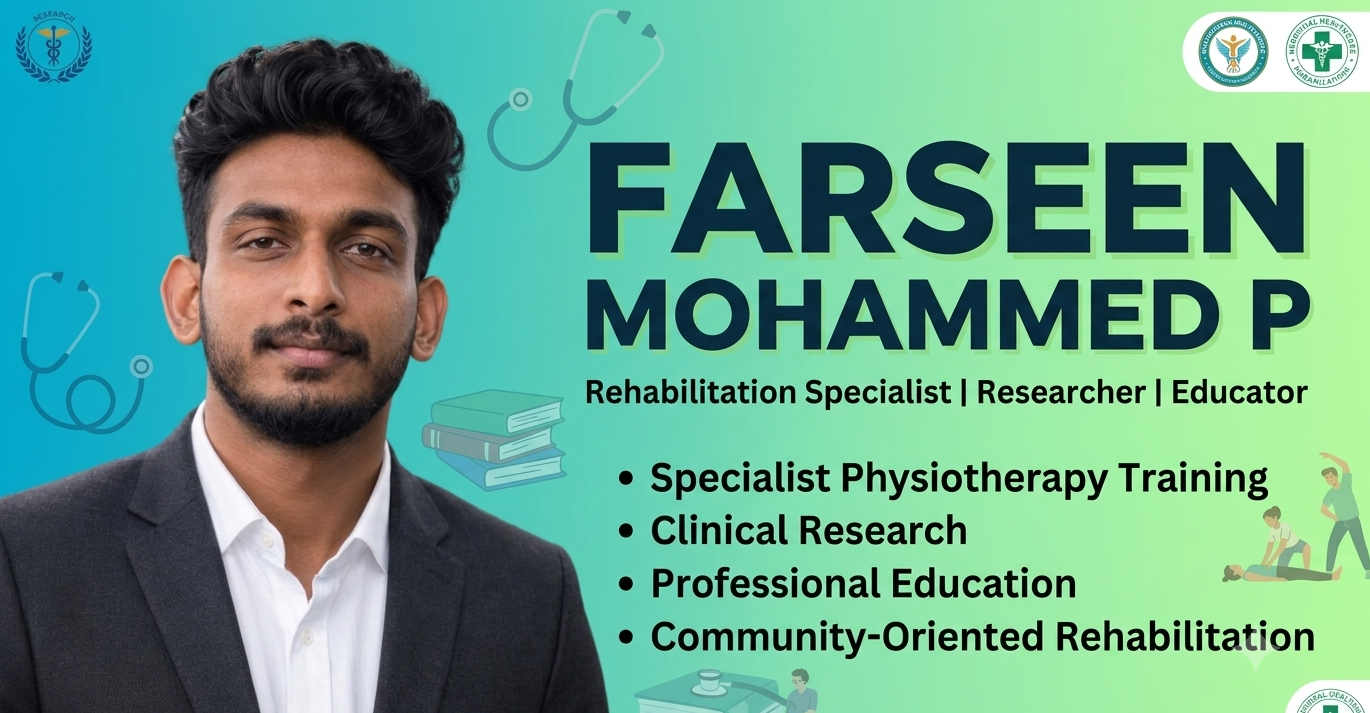
Mangaluru, Karnataka: Neurorehabilitation is an evolving area of healthcare that combines clinical assessment, therapeutic intervention, functional training and evidence-based decision-making. For Farseen Mohammed P, a specialist physiotherapist in neurosciences and clinical researcher, professional development in this field has involved a combination of postgraduate specialization, clinical exposure, rehabilitation training and research.
His career reflects an approach to neurorehabilitation that places functional recovery, therapeutic exercise and scientific evidence at the center of professional practice.
Understanding Neurorehabilitation as a Functional Process
Neurological conditions can affect movement, balance, coordination, strength, mobility and the ability to perform everyday activities.
Modern neurorehabilitation therefore involves more than treating an individual impairment. Rehabilitation programmes may also focus on helping individuals regain functional abilities and participate more effectively in daily life.
Farseen’s postgraduate specialization in neurophysiotherapy and neurorehabilitation has provided him with an academic foundation in this area.
Postgraduate Specialization in Neurosciences
Farseen completed his Master of Physiotherapy in Neurosciences at Yenepoya Physiotherapy College, Yenepoya (Deemed to be University), Mangaluru.
His postgraduate education was accompanied by clinical exposure at Yenepoya Medical College Hospital.
During this period, he developed experience working with neurological conditions including stroke, Parkinson’s disease, traumatic brain injury, Guillain–Barré syndrome and spinal cord disorders.
This combination of academic education and clinical exposure has shaped his professional focus on neurological rehabilitation.
Rehabilitation Through Functional Training
One important element of contemporary neurorehabilitation is functional training.
Rather than concentrating exclusively on isolated muscle performance, rehabilitation can incorporate activities that relate more closely to movement, mobility and everyday function.
Farseen has received clinical training in approaches including task-oriented training and the Motor Relearning Programme.
These approaches form part of his broader neurological rehabilitation training.
Neurodevelopmental Treatment Training
Farseen has also undertaken training in Neurodevelopmental Treatment (NDT).
His NDT-related training included functional improvement approaches for cerebral palsy and neuromotor disorders.
Additional NDT hands-on training and stroke-management education have contributed to his clinical development.
These experiences have expanded his exposure to structured neurological rehabilitation techniques.
Therapeutic Exercise in Neurorehabilitation
Therapeutic exercise is another important component of Farseen’s professional interests.
His postgraduate dissertation examined the effects of eccentric versus concentric strengthening on functional mobility in subacute stroke patients.
The research connected strengthening strategies with functional outcomes in stroke rehabilitation.
His subsequent systematic-review work has continued to investigate the role of strengthening interventions after stroke.
Research Supporting Clinical Practice
Farseen’s approach to rehabilitation is also connected with evidence-based physiotherapy.
He has developed experience in systematic reviews, scoping reviews and evidence synthesis.
His research portfolio includes investigations into stroke rehabilitation, Parkinson’s disease and exercise-based rehabilitation.
This research-oriented approach can help clinicians critically evaluate available evidence when considering rehabilitation interventions.
Stroke Rehabilitation as a Major Research Interest
Stroke rehabilitation represents one of the strongest themes in Farseen’s academic work.
His postgraduate dissertation investigated strengthening interventions in subacute stroke.
He has also worked on a systematic review examining the effectiveness of eccentric strengthening interventions on functional outcomes in adults following stroke.
At SYNERGOS 2026, he presented this systematic-review research and received the First Prize in the Postgraduate Category for Oral Paper Presentation.
Parkinson’s Disease and Physiotherapy
Farseen’s work in neurorehabilitation also extends to Parkinson’s disease.
He contributed to the 2026 scoping review:
“Timing of Dopaminergic Medication Relative to Physiotherapy Delivery in Adults with Parkinson’s Disease: A Scoping Review.”
The research examines the available evidence surrounding the timing of dopaminergic medication and physiotherapy delivery.
As second author and corresponding author, Farseen contributed to research examining an issue at the intersection of medication management and rehabilitation delivery.
Linking Rehabilitation With Evidence Synthesis
Evidence synthesis can play an important role in modern healthcare because individual research studies may provide only limited information.
Systematic reviews and scoping reviews can help researchers understand the existing body of evidence surrounding a particular clinical question.
Farseen has pursued additional training in this area, including a five-day international-level hands-on workshop on Systematic Review and Meta-Analysis conducted by IIRA, Mumbai, from 27 to 31 August 2026.
Looking Beyond a Single Condition
Although neurological rehabilitation is central to Farseen’s professional profile, his research interests are not restricted to one condition.
His research activities also include exercise-based cardiac rehabilitation and metabolic health.
An ongoing systematic review examines exercise interventions and their hepatic, metabolic, functional and muscle-strength outcomes in adults with metabolic dysfunction-associated steatotic liver disease.
This broader research exposure contributes to an understanding of rehabilitation as a multidisciplinary field.
Rehabilitation After Hospital Discharge
Modern rehabilitation also extends beyond the hospital environment.
On 5 September 2026, Farseen served as a resource person at a CME programme for nursing professionals at St. Joseph’s Mission Hospital, Anchal, Kerala.
His session was titled:
“Life After Discharge: Physiotherapy-Guided Secondary Prevention and Community Reintegration.”
The topic emphasized the importance of rehabilitation planning after discharge and the transition toward community-based functional participation.
Communication and Multidisciplinary Practice
Neurorehabilitation often involves collaboration among physiotherapists, doctors, nurses, occupational therapists, speech and language professionals, caregivers and other healthcare providers.
Farseen’s participation in professional education and CME activities reflects an interest in communicating rehabilitation concepts beyond physiotherapy alone.
His multilingual abilities in English, Malayalam, Hindi, Tamil and Kannada also support communication across different professional and regional environments.
Continuing Professional Development
Farseen’s approach to neurorehabilitation continues to develop through additional professional education.
His training includes courses and workshops related to stroke management, NDT, motor relearning, clinical research, good clinical practice and systematic-review methodology.
He has also completed ACE Health Coach Certification and a postgraduate diploma in nutrition.
These additional qualifications provide complementary perspectives on exercise, health and rehabilitation.
A Research-Informed Rehabilitation Perspective
Farseen Mohammed P’s professional profile demonstrates an effort to connect three important components of modern neurorehabilitation:
Clinical training provides practical experience with neurological conditions.
Therapeutic intervention provides strategies for improving movement and function.
Research and evidence synthesis provide a framework for evaluating rehabilitation approaches.
Together, these elements contribute to a research-informed professional approach to physiotherapy.
Future Directions in Neurorehabilitation
Neurorehabilitation continues to evolve alongside developments in clinical research, exercise science, technology and multidisciplinary healthcare.
Farseen’s ongoing research in stroke rehabilitation and motor learning, together with his work in Parkinson’s disease and therapeutic exercise, places him within this developing field.
His continued participation in research and professional education may provide opportunities to further explore rehabilitation interventions and functional outcomes.
Conclusion
Farseen Mohammed P’s approach to modern neurorehabilitation is shaped by postgraduate specialization, clinical experience, therapeutic exercise training and research.
His work demonstrates an interest in understanding neurological rehabilitation not only as a clinical service but also as an area requiring continuous evaluation, scientific inquiry and professional development.
With experience spanning stroke rehabilitation, Parkinson’s disease, neurological clinical training, evidence synthesis and professional education, Farseen is developing a career focused on the intersection of neuroscience, physiotherapy and evidence-based rehabilitation.
